The Creevey Papers

Thomas Creevey


Thomas Creevey was born in Liverpool in 1768, allegedly the son of William Creevey, a Liverpool merchant, he is believed by some to have been the illegitimate son of Charles William, 1st Earl of Sefton. After graduating from Queens College, Cambridge in 1789 he was called to the bar in 1794. In 1802 he married Eleanor Ord, the Widow of William Ord a Northumberland Landowner and M.P. for Newcastle, and daughter of Charles Brandling of Gosforth. Eleanor was also a distant cousin of Charles Grey and a friend of the Prince of Wales. A socially and politically advantageous match, it was no coincidence that in the year of his marriage, Creevey also became M.P. for Thetford.

Creevey was a Whig and a follower of Charles James Fox. In 1806, when the brief “All the Talents” ministry was formed, he was given the office of secretary to the Board of Control. In 1830, when next his party came into power, Creevey, who had lost his seat in Parliament, was appointed treasurer of the ordnance; and subsequently Lord Melbourne made him treasurer of Greenwich Hospital (1834).

Although he had a distinguished political career, Creevey is better remembered for the time he spent away from Britain. In 1814 he and his then very unwell wife, left England for Brussels where they were to spend the next five years. It was during this time that Creevey was to come to know the Duke of Wellington, and to have the distinction of being the first civilian to interview him after the Battle of Waterloo. It was during that interview that Wellington made his famous assessment of the battle “It has been a damned nice thing. The nearest run thing you ever saw in your life.”


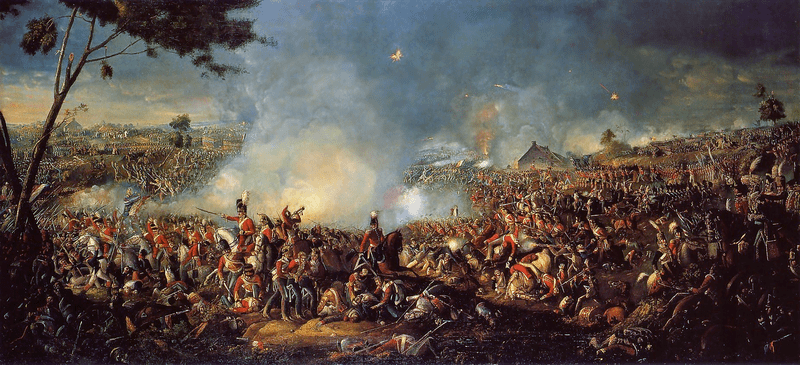
Waterloo


Creevey had intended to write a history of the times he lived in, and apparently to that end collected and saved his own voluminous correspondence. He was a man of some considerable charm and this along with his intellect, meant many of the leading political figures of the day valued his company. As such he was afforded an uncommon degree of intimacy with them. His wife died in 1818 leaving Creevey with very scant means of his own. However, his popularity meant that his friends often looked after him although it was noted by Charles Cavendish Fulke Greville in 1829 “old Creevey is a living proof that a man may be perfectly happy and exceedingly poor. I think he is the only man I know in society who possesses nothing.”


Creevey’s “Execrable” handwriting.


Creevey died in 1838 and was largely forgotten to history. His papers were consigned to the attic of Whitfield Hall in Northumberland, after having passed to his stepdaughter Elizabeth Ord. As well as his correspondence, the papers include his journals, many were faithfully kept by Elizabeth, indeed she saw fit to transcribe many of them in her own hand. An act that has been much praised by those who have studied Creevey’s papers who describe his own writing, without exception, as “simply execrable”. However, Creevey is also known to have kept a copious diary covering 36 years of his life, but it was apparently destroyed sometime after his death by friends fearing exposure of the contents.

A chance enquiry during a tour of the house in 1900 led to the publication of ‘The Creevey Papers’. These two volumes captured the late Georgian era with sparkling political and social gossip and an almost Pepysian outspokenness, and they took London by storm. No one described more graphically the appearance, or recorded more faithfully the looks and the talk, of the royal personages and major politicians of the time. Not least among his humorous touches is the extensive use of nicknames for many of the major personages of the day, “Prinney” for George IV; “Beelzebub” for Henry Brougham; “Madagascar” for Lady Holland and “the beau” for the Duke of Wellington. Others include “Og of Bashan” “King Jog” “King Tom” “Niffy Naffy” “Slice” “Snip” and “Clunch,”.


A summary of royalties for the publication of The Creevey Papers.


The Creevey Papers are held by Northumberland Archives as part of the Blackett-Ord Family of Whitfield Collection. Due to its large size there is a huge amount of material not included in the original ‘The Creevey Papers’ publication, or its subsequent iterations. It’s likely that further exploration of the material could yield even more from this extraordinary record of a man’s life through a turbulent time in history.

The Murder of Joe the Quilter

On 3 January 1826 a 76 year old man named Joseph Hedley was brutally murdered in his cottage in the parish of Warden. Joseph’s throat and face were slashed and multiple stab wounds were inflicted upon his body. He was commonly known as Joe the Quilter due to his skill with needlework. He was a quilter by trade and travelled around the country seeking employment. Joe’s skills in quilting were celebrated, and his handiwork was known in various parts of England, Ireland, Scotland and America.

On the evening of the murder, Joe obtained a pitcher of milk, a pound of sugar, a sheep’s head and pluck (offal) from farmer’s wife Mrs Colbeck of Warwick Grange. At approximately 6pm William Herdman, a labourer living in Wall called in on Joe on his way home from work at the local paper mill and sat with him for a short time. Joe had a good fire going and was busy preparing some potatoes for his supper.  Around 7pm Mrs Biggs, a female pedlar from Stamfordham knocked at the cottage to ask directions to Fourstones having missed the turning due to the excessive darkness of the night. Joe came to the door and gave her the necessary directions. Apart from the murderer(s), Mrs Biggs is said to be the last person to have seen him alive.


Plan of Joe’s cottage where the murder took place


At approximately 8pm a Mr Smith of Haughton Castle rode past the cottage on his way home from Warden and all at the cottage was silent and dark. It is suspected that the deed took place between 7-8pm. Concern for Joe’s safety grew after his neighbours didn’t see the elderly man for a few days. It was reported that there appeared to be marks of blood in the snow outside the cottage and marks to indicate that a struggle had taken place. His neighbours found the cottage door locked and after knocking several times with no reply proceeded to break into the property. They were faced with a chilling sight as parts of the walls of the cottage were stained with blood and a quilt spread on a frame bore a distinct mark of a bloody handprint. The pitcher of milk, sheep’s head and pound of sugar which he had recently purchased were found lying on a table. A search of the house was conducted and nothing was found. An old outhouse which stored wood and coals was then searched and Joe’s body was discovered. Both cheeks were cut widely open with deep wounds. A garden hoe was found laid across his chest. A coal rake was also found with its shank bent. As two weapons were discovered it then raised a suspicion that there were 2 murderers. Joe was found with knife wounds on his hands so had obviously fought with the attacker(s).

The small cottage had been ransacked and bore evidence of a struggle. All of his boxes and drawers had been disturbed and it was believed that two silver tablespoons, four teaspoons and two old fashioned salt cellars of silver net-work had been stolen.The bed tester had been violently torn down and the face of the clock broken. Prints of 3 bloody fingers were distinctly visible on the chimney jamb . The plates on the dresser were also streaked with blood. Outside in the lane some clogs were found and a small piece of coat was discovered on a hedge.It was supposed that Joe had fought hard with the murderer(s) and had managed to escape about 100 yards from the cottage before he was caught. Judging by the marks in the snow it appeared that a struggle had taken place and then Joe had been overcome and dragged back and murdered. After this had taken place the cottage door had been locked on the outside and the key taken away.


Reward Poster


A one hundred guineas reward was offered to catch the perpetrator(s) of the atrocious murder . The reward was offered from the Overseers of the Poor of the parish of Warden on 17 January 1826. Home secretary Robert Peel offered his majesty’s full pardon to any accomplices who came forward with information (as long as they were not the actual murderer). A jury returned a verdict of wilful murder against some person or persons unknown.  Although several people were arrested and questioned nobody was ever charged and sadly the murder of Joe the Quilter was never solved. Joe was buried in Warden churchyard on 10 January 1826. On his burial entry the word murdered can clearly be read underneath his name.


On Wednesday 29 March 1826, an auction was held to sell the household furniture belonging to the ‘late unfortunate Joseph Hedley, commonly called Joe The Quilter’.


Auction Poster


Northumberland and Durham Sword Dancing

‘Calling on’- song


The image above is one of the earliest examples of a Sword Dancing ‘calling -on‘song. Sword Dancing in Northumberland and Durham is very peculiar, for unlike the sword dances found elsewhere in the country, the sword in the Northern area is two handled.

The earliest written description of sword dancing in Northumberland is part of the seasonal festivities written by John Wallis, Curate of Simonburn in his book “The Natural History and Antiquary of Northumberland” published in 1769, he relates the dances still performed at Christmas time he states:

“Young men march from village to village, and from house to house with music before them, dressed in antic attire, and before the vestibulum or entrance of every house entertain the family with the Motus incompositus, the antic dance, or Chorus armatus, with swords or spears in their hands, erect and shining. This they call, the Sword-Dance. For their pains they are presented with a small gratuity in money, more or less, according to every householders ability, their gratitude is expressed by firing a gun. One of the company is distinguished from the rest by a more antic dress; a fox’s skin generally serving him for a covering and ornament to his head, the tail hanging down his back. This droll figure is their chief or leader he does not mingle in the dance”.

On the 7th January 1843 the Newcastle Journal published an article formerly printed in The Times of a custom called “Sword dancing”

“The sword-dancers are men entirely or chiefly composed of miners or pitmen, and of persons engaged in the various other vocations of a colliery, who during the week intervening between Christmas and New Year’s Day, perambulate the country in parties, consisting of from twelve to twenty, partly in search of money, but much more I believe, of adventure and excitement”  “on these occasions they are habited in a peculiarly gaudy dress, which, with their dancing principally attracts attention. Instead of their ordinary jackets they wear others, composed of a kind of variegated patchwork which, with their hats, are profusely decorated with ribands of the gayest hues, prepared and wrought by their sisters or sweethearts, the sword dances being usually young and unmarried men. This, with slight individual variations is the description of dress worn by all the members of a sword-dancing party, with the exception of two conspicuous characters invariably attached to the company and denominated amongst themselves respectively the “Tommy” and the “Bessy”  These two personages were the most frighteningly grotesque dresses imaginable; the former being usually clad in the skin of some wild animal, and the latter in petticoats and the costume of an old woman; it is the office of those two individuals, to go round amongst the company which collects to see them dance, and levy contributions in money; each of them being furnished for this purpose with a huge tin or iron box which they rattle in the faces of the bystanders, and perform other antics and grimaces to procure subscriptions. A fiddler also is an indispensable attaché to a company of sword dancers”….”The sword dancers are each furnished with long steel wands, which they call swords, and which they employ with a very peculiar and beautiful effect during the dance”.

In Northumberland the villages which continued the tradition into the 20th century were Amble, Bedlington, Earsdon, Monkseaton, Newbiggin by the Sea, Prudhoe and Mickley, Walbottle and Westerhope.


Sword Dancing Team


In 1910 Cecil Sharp, keen folksong and folkdance collector was invited north, by William Parker Brewis of the Society of Antiquaries of Newcastle upon Tyne, and between 1910 and 1922 he collected five sword dances, and published them in the book “The Sword Dances in Northern England”, and within the first few months of publication was using the dances in the English Folk Dance Society as part of their “Advanced Certificate” course of folk dance, what the sword dancers themselves made of this we shall never know.

The term “Rapper” for the name of this kind of dancing comes from an interpretation of the poor written word which Cecil Sharp wrote in his notes as to the name of the implements the Earsdon men were holding in their hands, no earlier account of this word in combination with Sword Dancing has been found.

In Northumberland and Durham today, very few of the traditional Sword Dancing sides still perform. High Spen Blue Diamonds in County Durham, being one of the very last, passed down through the generations of the Forster family. Even though there are little traditional sides left, the dance still goes on with the likes of the Demon Barbers, from Newcastle upon Tyne bringing back the excitement of the fast dance, or the Monkseaton Morris Men who still perform every New Year’s Day at 12 noon outside the Ship Inn, Monkseaton. As traditions change and die out and everywhere becomes less magical and more mundane, it is good to support and remember the little things that make the North East a little bit different from anywhere else.


Some information kindly supplied by Phil Heaton, author of “Rapper – The Miners’ Sword Dance of North East England”.


Season’s Greetings!